REVIEW · PARIS
Paris: Guided Tour of the Must-Sees of the Louvre Museum
Book on GetYourGuide →Operated by Memories France · Bookable on GetYourGuide
The Louvre feels endless until you have a plan. This tour is built to tame the crowds with pre-reserved entry and a guide who makes icons like the Mona Lisa feel understandable, not just famous. You meet right by the Louvre entrance area and walk in together, so you’re not spending your time figuring out where to go next.
My two favorite parts are the streamlined access (it’s designed to help you avoid the ticket line) and the way the guide connects works across time, from ancient worlds through Renaissance scenes and French painting. The only real drawback: even with reserved entry, expect security lines during busy periods, plus a fair amount of walking in about a 90-minute sprint.
In This Review
- Key Highlights Worth Your Attention
- Where You Start: Arc du Carrousel and the Walk Into the Louvre
- Getting Past the Crowd: Pre-Reserved Tickets, Then Security
- The 90-Minute Game Plan: How the Tour Keeps You Oriented
- The Must-See Route: Mona Lisa, Venus de Milo, Winged Victory
- Mona Lisa: More Than the Smile
- Venus de Milo: Why This Sculpture Feels Instant
- Winged Victory: The Power of a Single Figure
- Beyond the Big Three: How the Tour Treats Other Collections
- The Louvre as a Royal Palace: Why the Setting Matters
- Navigating After the Tour: Where to Spend More Time
- Value for $82: What You’re Really Paying For
- Who This Tour Fits Best (and Who It Doesn’t)
- Booking Tip: How to Make Your Short Visit Feel Longer
- Should You Book This Louvre Highlights Tour?
- FAQ
- How long is the guided tour?
- Where do we meet for the tour?
- Are tickets included?
- Does this tour help you avoid the ticket line?
- What language is the tour guide?
- What’s included besides the guide?
- What should I bring?
- Is a stroller or luggage allowed?
- Is the tour wheelchair friendly?
- Can I cancel if my plans change?
Key Highlights Worth Your Attention
- Skip-the-ticket-line focus so you spend more time looking and less time waiting at the main entrance area.
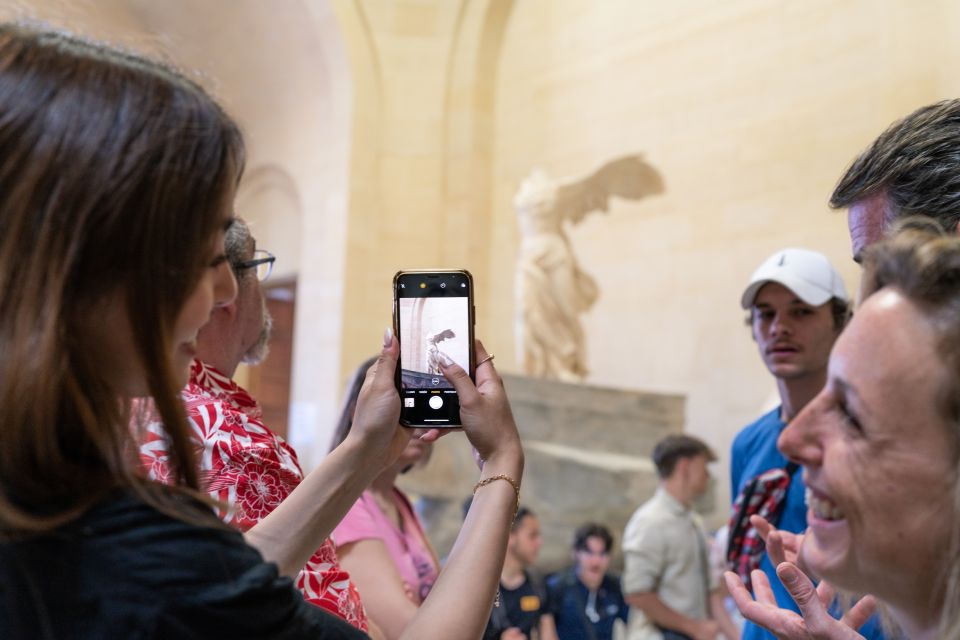
- Headsets included, which make it easier to hear your guide even when you’re moving with the group.
- The must-see trio is prioritized: Mona Lisa, Venus de Milo, and Winged Victory—plus other stops along the way.
- A timeline route in short form covering major areas like Italian Renaissance, ancient Egypt, Greece and Rome, and 19th-century French paintings.
- Small-group pacing that aims to keep you oriented in a museum that otherwise overwhelms even motivated wanderers.
Where You Start: Arc du Carrousel and the Walk Into the Louvre
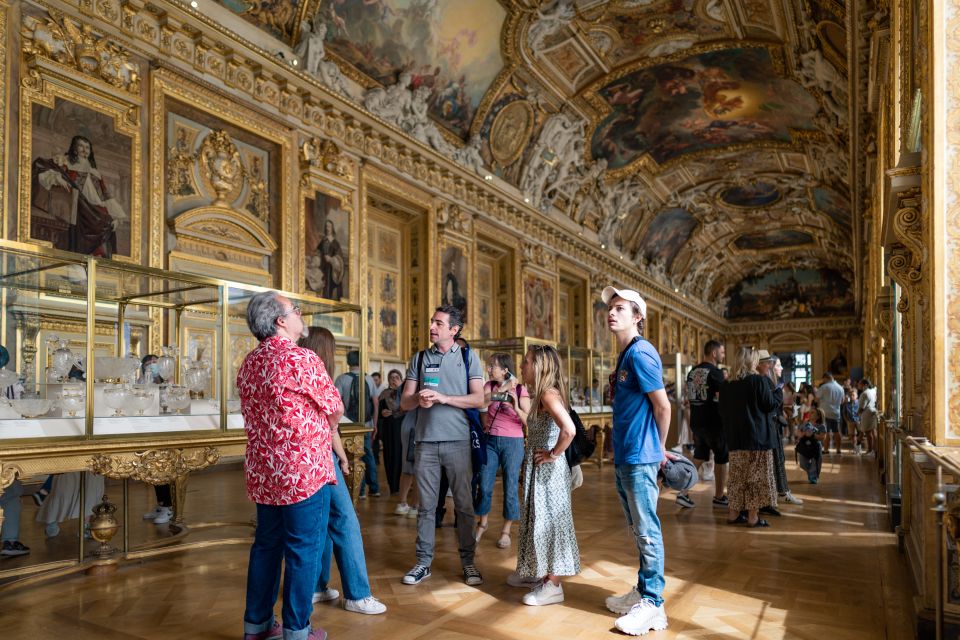
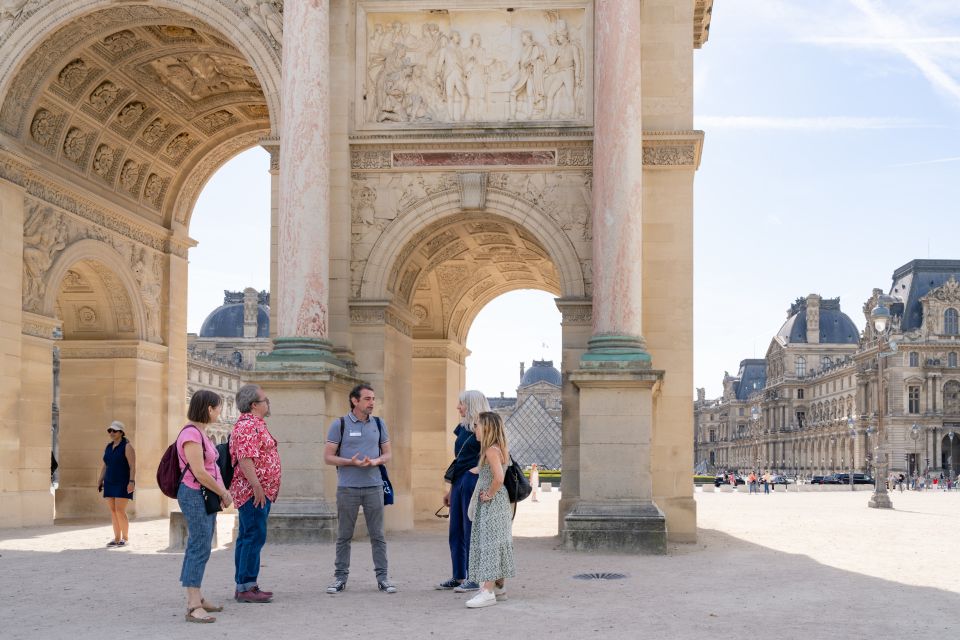
You begin at the Arc de Triomphe du Carrousel, at the Louvre’s entrance area, opposite the glass pyramid. That location matters. It’s close enough to get oriented fast, but far enough that you avoid the worst of the “lost in the plaza” feeling you can get when you show up on your own.
Your guide is easy to spot: they wear a guide card on an orange lanyard with the Memories France logo. From there, the group walks into the museum together. That little act—moving as a unit—saves you from turning the Louvre into a navigation project.
This is also where you get the first practical win: a guide can set expectations immediately. At the Louvre, the hardest part is usually not seeing art. It’s knowing what to see first, and how to keep that plan from collapsing when crowds change direction.
You can also read our reviews of more guided tours in Paris



Getting Past the Crowd: Pre-Reserved Tickets, Then Security
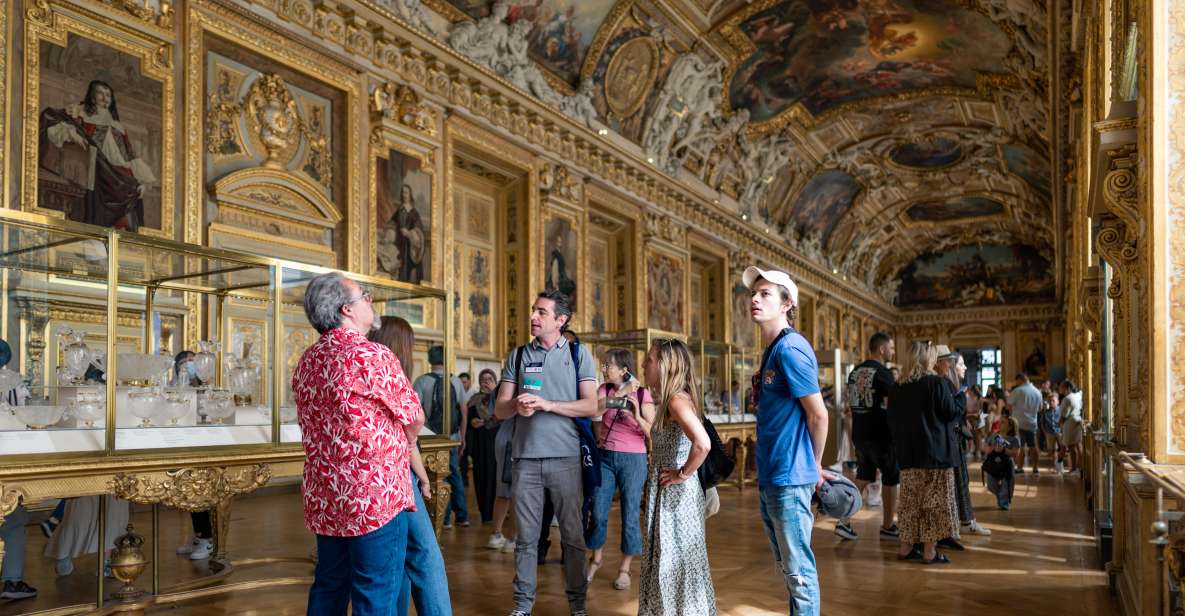
Pre-reserved tickets are included, and the tour is designed to skip the ticket line. That’s a big deal at the Louvre, where the queue can eat up a chunk of your day and leave you standing around instead of studying paintings.
Still, there’s one logistical reality you should plan for: even with reserved entry, there may be a wait at security. During high season, it can be up to 20 minutes. In other words, the tour doesn’t turn the Louvre into a quiet museum. It just helps you get through the longest line first.
The practical takeaway: wear comfortable shoes and keep your expectations realistic. A well-led group tour works because your guide accounts for crowd flow inside the building, not because everything is magically line-free.
The 90-Minute Game Plan: How the Tour Keeps You Oriented
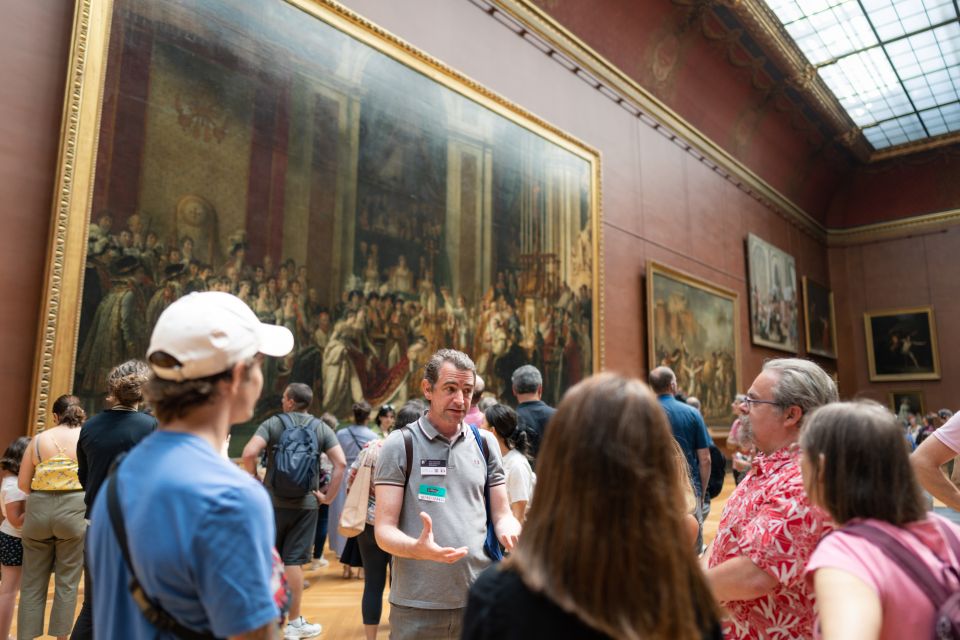
This is a short visit, and the structure reflects that. The guided portion is listed as 1.5 hours (about 90 minutes), and the overall experience is meant to feel like a quick hit of the Louvre’s best-known works and major collections.
That time constraint is exactly why the tour has value. The Louvre is huge. If you show up with a loose plan, you can end up chasing the Mona Lisa while missing everything around it—or vice versa. Here, the guide steers the route so you leave with a coherent “greatest hits” understanding rather than a checklist of random rooms.
One of the most praised elements from real guide styles is crowd management. Guides such as Marjolein, Antonio, Anton, Sara, and Sylvanie are repeatedly noted for handling hotspots efficiently and keeping the group together. That matters because the Louvre’s busiest areas are also where you lose time fastest on your own.
You also get headsets, so you can keep walking while still hearing commentary clearly. In a museum full of constant movement and shifting groups, it’s the difference between missing the story and actually following it.
The Must-See Route: Mona Lisa, Venus de Milo, Winged Victory

Let’s talk about the reasons these works pull people in, because a guided approach changes how you experience them.
Mona Lisa: More Than the Smile
Everyone knows the Mona Lisa. The problem is that without context, you see a small painting behind glass and then you’re stuck in a crush of bodies trying to look.
A strong guide’s job is to help you focus. The tour is built so you reach this kind of “must-see” moment as part of a route, not as an isolated stop where you wait, stare, and then move on. Some guides (including Matt and others) are praised for helping groups get up front without losing the bigger narrative.
You can also read our reviews of more museum experiences in Paris






Venus de Milo: Why This Sculpture Feels Instant
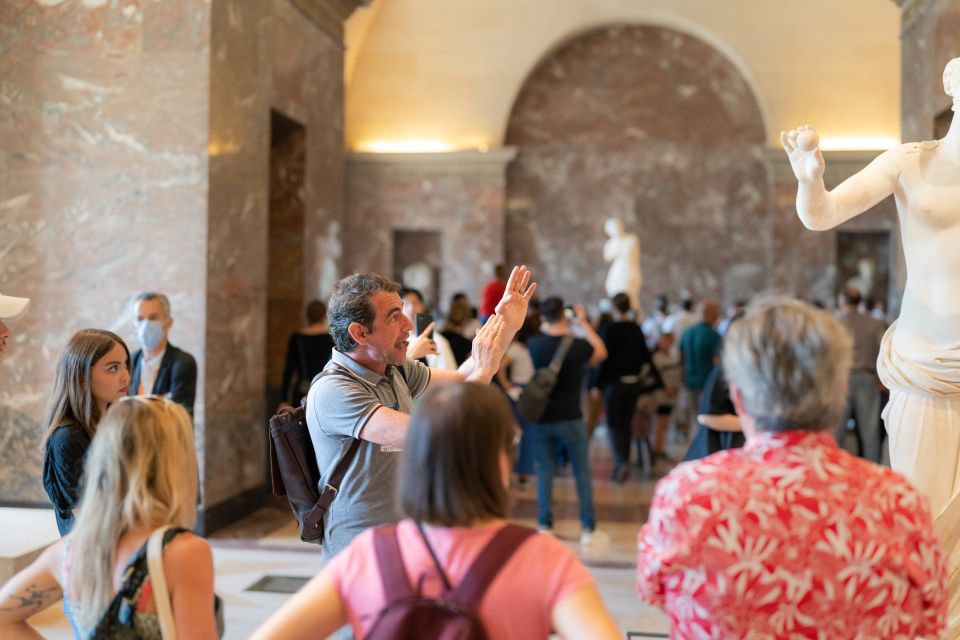
Venus de Milo is all about presence. It’s a famous form, but your ability to appreciate it depends on where you stand and what you’re prompted to notice: the pose, the proportions, the physical impact of sculpture in a gallery.
This tour includes Venus de Milo as a core stop for a reason. Your guide helps you look at it like a work of art, not just a famous silhouette that you’ve seen in postcards.
Winged Victory: The Power of a Single Figure
Winged Victory is another icon where context helps. In person, it’s easier to feel the drama of the composition—especially when your guide explains what makes it so compelling in the tradition it represents.
That’s the tour’s pattern: the guide steers you to the works everyone wants, and then gives you just enough art-history framing to make those “wow” moments land.
Beyond the Big Three: How the Tour Treats Other Collections
The Louvre isn’t one museum. It’s multiple worlds connected by galleries. This tour reflects that by covering major categories across time, including Italian Renaissance, ancient Egypt, Greece and Rome, and French paintings of the 19th century.
That broad sweep is useful because it gives you a map of what the Louvre actually contains. You don’t have to become an art historian in 90 minutes. You just need enough context to decide what you want to revisit later.
Some guides are also praised for bringing in variety beyond the headline works. For example:
- People mention learning things through the Medieval area when certain guides incorporate it.
- Others note how the tour emphasizes specific eras more heavily, like the Roman-centered feel in at least one experience.
So while your “must-sees” are consistent, your guide’s storytelling style may shape what stands out next. If you’re choosing this tour, that’s a good thing—because the guide is there to connect dots.
The Louvre as a Royal Palace: Why the Setting Matters
One of the most meaningful parts of this kind of guided visit is the way it changes how you interpret the building itself. You walk through sumptuous corridors that once belonged to royalty, and the tour frames the Louvre not just as a collection, but as a former royal palace.
That context helps because the Louvre’s art is displayed in a way that reflects power, patronage, and prestige. Without that lens, it’s easy to view the museum as a neutral box. With the palace context, you start noticing why certain rooms and sequences feel grand and ceremonial.
Guides like Sara are specifically described as sharing history and museum context in a clear, chronological way. That style works especially well if you’re new to the Louvre and want a mental timeline that makes the building’s layout feel less chaotic.
Navigating After the Tour: Where to Spend More Time

The best tours don’t just end. They help you decide what to do next.
A recurring theme in praise is that the guide makes sure you see the highlights but also leaves you in a good position to continue. When you finish a guided Louvre session with a stronger sense of the museum’s organization, you’re less likely to wander randomly and more likely to find the rooms you actually care about.
If you already know you’ll return later, this tour is a fast primer. If this is your only Louvre visit, it acts like a curated “route memory” so you can go back to the pieces that genuinely stuck in your mind.
Value for $82: What You’re Really Paying For
At $82 per person, this tour costs more than showing up and buying a ticket yourself. The value isn’t the ticket alone. It’s the time savings and direction.
Here’s what you’re effectively purchasing:
- Pre-reserved entrance and help avoiding the ticket line
- An English-speaking guide who provides explanations (and uses headsets to keep you connected)
- A route that prioritizes major works and major collections without you having to plan every room
If you’re short on time, the math usually works in favor of the tour. The Louvre rewards preparation, and this experience bundles preparation into the guide’s plan.
If you have all day and love wandering with zero structure, you can always go on your own. But if you want a high-impact first Louvre visit and you don’t want to lose hours to crowd flow and decision fatigue, $82 can feel like a practical shortcut.
Who This Tour Fits Best (and Who It Doesn’t)
This is a great fit if you:
- Want to see the biggest icons like Mona Lisa, Venus de Milo, and Winged Victory without turning it into a scavenger hunt
- Prefer a clear route through major eras (ancient worlds, Renaissance, and 19th-century French painting)
- Like hearing stories while you walk, thanks to headsets
- Would rather spend time looking than figuring out logistics in a maze of galleries
It’s not a good fit if you rely on wheelchair access, because the tour is listed as not suitable for wheelchair users. It also isn’t set up for people bringing strollers or luggage/large bags. You’ll want to travel light.
Booking Tip: How to Make Your Short Visit Feel Longer
A 90-minute Louvre tour works best when you come prepared:
- Wear comfortable shoes. There’s walking, and you’ll be moving at a guided pace.
- Bring an ID or passport.
- Keep your bag small enough to meet the museum rules for luggage/large items.
If security queues slow entry, that doesn’t mean the tour fails. It just means you should protect your energy early and stay flexible. The guide’s strength is in handling the museum’s flow once you’re inside.
Should You Book This Louvre Highlights Tour?
If you’re visiting the Louvre for the first time and you want the real heavy-hitters with context, yes—book it. The value is strong when time is limited, because the tour combines pre-reserved access with a tight route and clear storytelling.
Skip this only if you’re determined to wander freely for hours, or if wheelchair access is a requirement. Otherwise, this is the kind of Louvre experience that helps you leave with names, eras, and meaning—without spending your day stuck in front of a map wondering what you’re supposed to see next.
FAQ
How long is the guided tour?
The guided experience is listed as 90 minutes.
Where do we meet for the tour?
Meet at the Arc de Triomphe du Carrousel du Louvre, opposite the glass pyramid. Your guide will be wearing an orange Memories France lanyard.
Are tickets included?
Yes. Pre-reserved entrance tickets to the Louvre are included.
Does this tour help you avoid the ticket line?
Yes. The experience is designed to skip the ticket line, though security lines can still create waiting time.
What language is the tour guide?
The tour is offered in English.
What’s included besides the guide?
Headsets are included, along with the guided visit and pre-reserved entrance tickets.
What should I bring?
Bring a passport or ID card and wear comfortable shoes.
Is a stroller or luggage allowed?
No strollers are allowed, and luggage or large bags are not allowed.
Is the tour wheelchair friendly?
No. The tour is listed as not suitable for wheelchair users.
Can I cancel if my plans change?
Yes. Free cancellation is offered up to 24 hours in advance for a full refund. Refunds aren’t possible for missed tours.