REVIEW · PARIS
Classic 2CV Tour paris 2h
Book on GetYourGuide →Operated by Lapegasebleu · Bookable on GetYourGuide
Paris looks different from a 2CV. I love the slow, easy pace and the chance to take photos from streets you usually miss, and the guided stops at big landmarks keep it feeling grounded. One thing to consider: it’s a tight 2-hour loop, so you’ll see plenty, but you won’t have long, sit-down time at each monument.
The sunroof makes the whole experience feel open-air and cinematic, and the photo shoot angle helps you come home with more than just phone snapshots. The ride also has that quirky, old-school charm that makes even a familiar boulevard feel like a movie set. Plan for a few chilly moments if the weather turns, since you’re very much outside the car.
In This Review
- Key things to love on this Classic 2CV Paris tour
- Time travel on four wheels: why the Citroën 2CV works so well in Paris
- Price and value: what $256 per group really buys you
- Meeting at Champ-de-Mars and timing your expectations for 2 hours
- Spot 1 to 3: Champ-de-Mars, Eiffel Tower, and Trocadéro garden angles
- Triumphal Axis highlights: Arc de Triomphe, Champs-Élysées, Grand Palais, Petit Palais
- Pont Alexandre III to Place de la Concorde: bridges, government landmarks, and classic Paris views
- Madeleines to the Louvre area: Place Vendôme, Opéra, Louvre Museum, and Pont Neuf
- Notre-Dame, Latin Quarter, Pantheon, and Luxembourg Gardens: the “old Paris” finale
- The guide factor: how local stories make the monuments feel personal
- Photo shoot strategy: how to get the best images in a 2CV
- Who this tour suits best (and who might want another plan)
- Should you book the Classic 2CV Tour Paris?
- FAQ
- How long is the Classic 2CV Tour Paris?
- Where do we meet for the tour?
- Does the tour include a guide and what languages are available?
- How many people are included in the private group?
- What’s included in the price?
- What isn’t included?
- Is smoking allowed in the car?
Key things to love on this Classic 2CV Paris tour
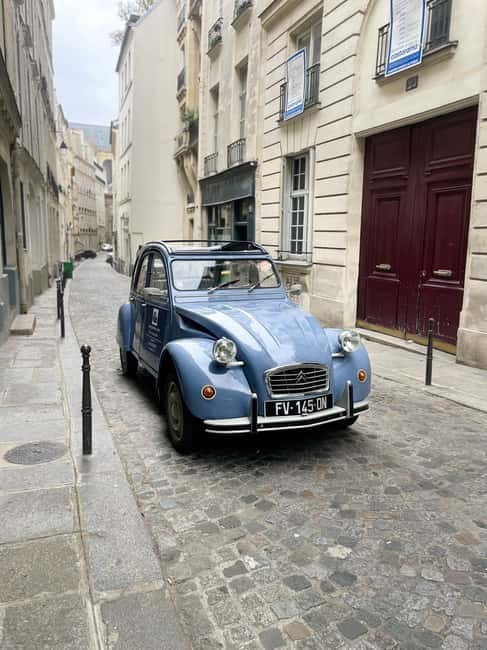
- Vintage 2CV vibe: open-air views and a 1940s feel as you roll past famous sights
- Photo-friendly routing: chances for angles on major monuments and smaller photo lanes
- Guided landmark route: you’re not just driving, you’re getting context for what you see
- Hotel pickup included (confirm details): helps this feel smooth, not logistically stressful
- Private group up to 3: more flexibility and less crowd noise than bigger tours
Time travel on four wheels: why the Citroën 2CV works so well in Paris
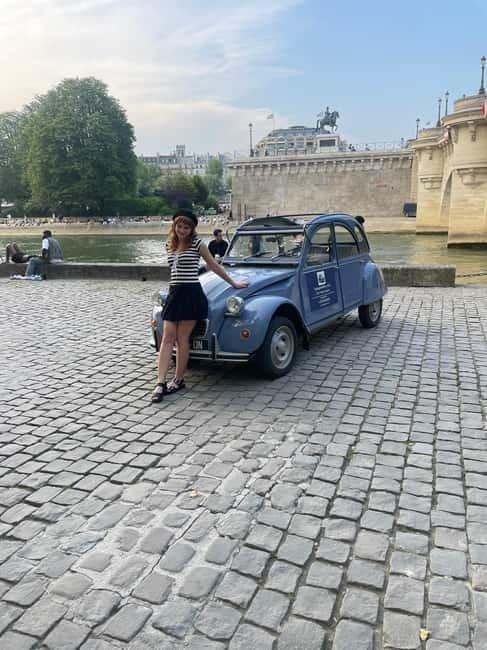
Paris is packed with places you’ve seen on postcards. The trick is seeing them in a way that doesn’t feel like a checklist. A Citroën 2CV helps because it’s slow, compact, and a bit unpredictable in the best way. It forces you to notice details: the rhythm of streets, the way pedestrians flow, and the fact that Paris isn’t just boulevards—it’s also side lanes and turning corners that open up sudden views.
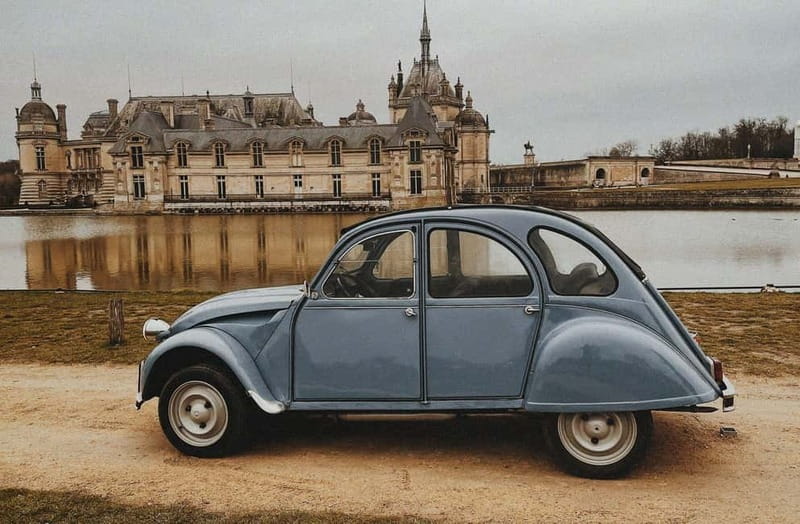
I also like that the ride is framed as a nostalgic experience. The 2CV is an iconic French car (built from 1948 to 1990), and the whole setup leans into that retro feeling. The sunroof is the practical magic: you’re not stuck with windows and reflections. You can actually look up at architecture as you move past it, and your photos benefit from that clearer line of sight.
One note on comfort: you’ll feel the weather more than on a closed bus. Bring a hat for sunny days, and sunscreen is smart if you’re out in daylight. If it’s windy or cooler, you may want a light layer.
You can also read our reviews of more tours and experiences in Paris

Price and value: what $256 per group really buys you
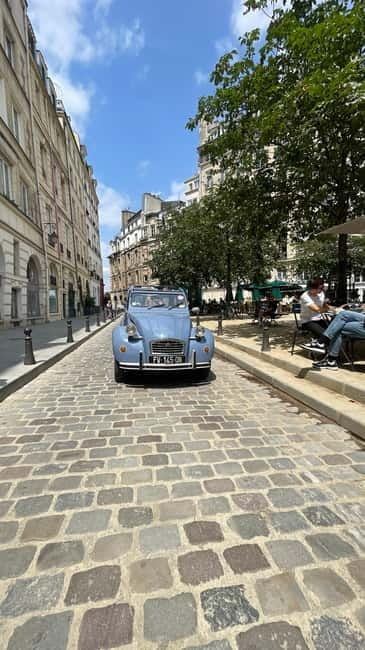
The price is listed as $256 per group up to 3 for a 2-hour private tour. That can sound steep if you’re comparing it to a public bus ticket. But this isn’t that kind of product.
You’re paying for a small, personal experience with:
- a guided tour in a vintage car
- photoshoot time built in
- pickup from the hotel (you should confirm the exact pickup and meet-point details for your address)
- a multilingual guide (French, English, Arabic, Hungarian)
- music (included)
Here’s how I think about value: in a big group, you spend time waiting, squeezing, and walking faster than you want. In a private 2CV, you can slow down, line up better for photos, and ask practical questions as you go. At the same time, this is still a 2-hour circuit, so the value comes from the experience and guidance, not from extended time at one single site.
If you’re 1 to 3 people who want a fun, guided way to get your bearings fast and see the big classics without rushing, this price starts to feel reasonable.
Meeting at Champ-de-Mars and timing your expectations for 2 hours
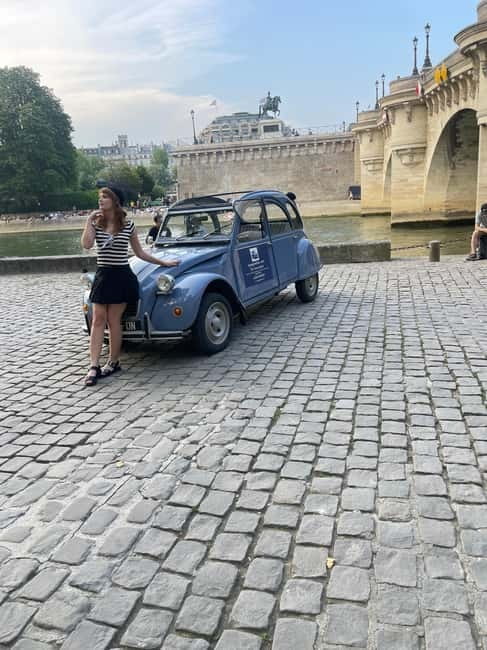
You start at Champ-de-Mars, behind the Eiffel Tower, and you end back at the same meeting point. That loop matters. It’s designed to pack in major sights without making you cross Paris for hours.
A good expectation to set: you’ll experience the route rather than “tour” one museum in depth. Think of it like a moving guided tour where each stop gives you a moment to orient yourself and snap photos, then you roll onward.
The guide gives context at the monuments as you pass or pause. The route also includes photo moments, so you’ll want your camera ready and your phone charged. A hat and sunscreen help you stay comfortable for the outdoor parts.
Also, plan around the rules: no smoking, and no food or drinks in the car. That’s mostly to keep the vintage interior clean, so it’s worth following.
Spot 1 to 3: Champ-de-Mars, Eiffel Tower, and Trocadéro garden angles
The first stretch sets the tone. You begin at Champ-de-Mars, the area that puts you in the right mood for Eiffel Tower views. Even before you fully park and take photos, you get that immediate sense of location, which helps you enjoy the rest of the route.
Next you reach the Eiffel Tower stop. This is where you’ll likely feel the best contrast between the monument’s scale and the 2CV’s small, vintage body. It’s a funny feeling—in a good way—watching something as iconic as the Eiffel Tower framed by a car that looks like it belongs in a different century.
After that comes Trocadéro Gardens for a guided stop. This is a viewpoint area people love for a reason: you get strong sightlines for photos, and the architecture around it gives you more than one framing option. The open-air feeling from the sunroof helps here because you’re not fighting glare the way you can in a closed vehicle.
What to watch for: keep your camera at the ready, especially if the guide slows near the best angles. When you’re on a short timetable, timing is everything.
Triumphal Axis highlights: Arc de Triomphe, Champs-Élysées, Grand Palais, Petit Palais
From Trocadéro, the route leans into Paris’s grand central energy. You’ll stop at Arc de Triomphe, with guided time that helps you understand what you’re seeing rather than just staring at it. The 2CV makes this feel a bit rebellious—instead of taking a big tour bus viewpoint, you’re gliding into the scene with a small vehicle that matches the streets more than the monuments do.
Then you roll through Champs-Élysées. This stretch is famous and busy, so having a guide is useful: you get orientation for what’s where, and you don’t spend your time trying to decode the city map from a moving car.
Two nearby cultural stops follow:
- Grand Palais
- Petit Palais
These aren’t just names to memorize. With guided explanations, you can connect why they matter and what you’re noticing when you look at the facades. Even if you’re not going inside, you’ll leave with a better sense of what makes these buildings part of Paris’s identity.
Photo tip: Arc de Triomphe and the surrounding streets can be tricky if you’re standing in the wrong spot. The advantage of this tour is that you pause with a plan. You’re less likely to miss the best angles when the schedule is tight.




Pont Alexandre III to Place de la Concorde: bridges, government landmarks, and classic Paris views
Next on your route, you’ll stop at Pont Alexandre III. Bridges in Paris can be pure photography—especially if you’re moving at a slower pace that lets you frame the city rather than just pass through it.
Then comes Les Invalides, another guided stop. This gives the route some weight. It’s one of those places where Paris history isn’t abstract; it’s right in the architecture and the site itself.
After that, you’ll hit l’Assemblée Nationale and then Place de la Concorde. These are different from the Eiffel Tower moments. Here, you’re learning how Paris organizes power and public space—wide plazas, major civic buildings, and the way streets funnel people to major landmarks.
What I like about this part of the tour is the balance. You get the dramatic postcard sights, but you also see where the city shows its governance and its public character. And in a 2CV, the wide streets feel even more open because the car doesn’t block your view.
Consideration: Place de la Concorde is a busy area. Even if the 2CV can get you into position for photos, you’ll still need to work with pedestrian flow. Keep it calm, and let the guide direct your camera position.
Madeleines to the Louvre area: Place Vendôme, Opéra, Louvre Museum, and Pont Neuf
Now the route pivots toward Paris’s “polish and sparkle” zone while still staying practical for photos.
You’ll stop at:
- Madeleine, Paris
- Opera, Paris
- Place Vendôme
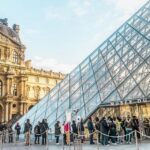
- Louvre Museum
Each stop gives you a different architectural vibe. The guide helps you connect the visual cues—so it’s not just, I saw a famous building. It’s, I understand why it’s considered important.
A stop at Pont Neuf follows. Pont Neuf is a classic anchor in the city’s river story. You’re not stuck in a museum corridor. Instead, you get a moving sense of geography—how Paris lines up across the Seine and how neighborhoods connect.
One more reason I like this sequence: it mixes art-and-power with street-level visual rhythm. When you’re in a vintage car, the city looks less like a map and more like a story unfolding.
Notre-Dame, Latin Quarter, Pantheon, and Luxembourg Gardens: the “old Paris” finale
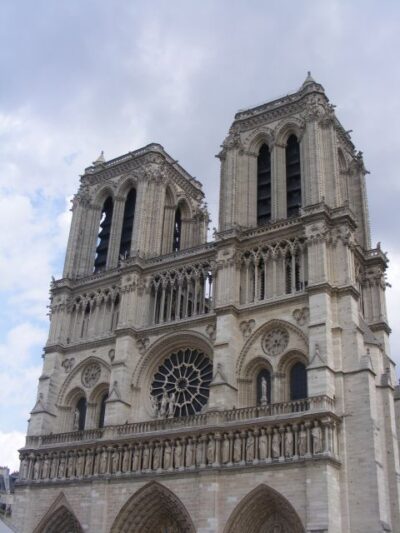
This is where the route turns more atmospheric. You’ll stop at Notre Dame Cathedral and then the Latin Quarter, both guided. Even if you’ve read about these places already, having a guide helps you connect streets and landmarks so you can mentally place the areas once you’re back walking.
Next you reach the Pantheon. It’s a different mood from the river and grand avenues, and it’s the kind of stop where guided context matters. You’ll better understand what you’re seeing and why the building commands attention.
Finally, you’ll end at Luxembourg Gardens before returning to Champ-de-Mars. Luxembourg Gardens is one of those stops where the city feels less like a rush and more like a pause. With the tour’s timeline, you won’t replace a long garden wander—but it works as a calm landing after big-city monuments.
Photo note: gardens and older streets can give you softer, more forgiving lighting depending on the time of day. If your plan is to return for a longer walk afterward, Luxembourg Gardens is also a solid place to start from.
The guide factor: how local stories make the monuments feel personal
This tour is built around the guide’s role. It’s not just about being driven from stop to stop. The guide explains what matters at each site, and the language options are broad: French, English, Arabic, Hungarian.
One of the best takeaways from a past experience is the kind of guidance that changes how you move through the city. In particular, Ahmed was noted for being accommodating and sharing local information, including how to go from one place to another. That’s practical knowledge you can use after the ride too.
I also like that the car isn’t just for show. Because it’s small and nimble compared to big vehicles, you’re more likely to get access to smaller narrow streets and lanes. That’s a big deal in Paris, where photo spots can be close together but blocked off for large vehicles. Those lanes often give you better angles than standing in the busiest tourist queues.
Photo shoot strategy: how to get the best images in a 2CV
This tour includes a photoshoot, and that means you should treat the 2 hours like an organized photo session, not an afterthought.
Bring:
- a camera (or make sure your phone is ready with enough storage)
- sunscreen and a hat
- a calm attitude for quick photo stops
For best results:
- keep your camera in reach during transfers between monuments
- be ready to frame quickly when the car pauses
- use the sunroof for shots that include skyline or upper architecture, not just building facades
And remember: the most interesting photos usually come from positioning and timing. That’s exactly what a guided tour helps with—when to stop, where to stand, and how to make the most of limited time.
Who this tour suits best (and who might want another plan)
This is a great fit if:
- you want a fun, guided orientation to Paris monuments
- you like quirky experiences and don’t mind slower movement
- you’re traveling in a private group of up to 3
- you value photos but want context too
It may not be ideal if:
- you expect long, in-depth museum time
- you’re seeking lots of walking on foot (this is primarily a car tour)
- you’re very sensitive to weather, since it’s an open-air feel with a sunroof
If you’re the type who enjoys big landmarks but also wants those “how did we end up there?” street photos, this route hits the sweet spot.
Should you book the Classic 2CV Tour Paris?
I’d book it if you’re planning a first or second-time Paris trip and you want a memorable way to see the major monuments in a tight timeline. The vintage 2CV experience is the main event, but the guided stops and photo plan are what turn it from a ride into a real tour.
Also, the private group up to 3 is a big advantage. You’ll feel less rushed, and the guide can tailor responses depending on what you care about. Just confirm pickup details for your hotel since the description includes pickup but also notes that hotel pickup/drop-off isn’t part of what’s listed—so you’ll want clarity before you go.
If you want a classic Paris highlight circuit with personality, this is one of the more fun ways to do it.
FAQ
How long is the Classic 2CV Tour Paris?
It runs for 2 hours.
Where do we meet for the tour?
The meeting point is Champ-de-Mars, behind the Eiffel Tower.
Does the tour include a guide and what languages are available?
Yes. The tour includes a live guide, and languages listed are French, English, Arabic, and Hungarian.
How many people are included in the private group?
It’s a private group for up to 3 people.
What’s included in the price?
Included items are a guided tour in a vintage 2CV, a photoshoot, pickup from the hotel (confirm exact pickup details), and music.
What isn’t included?
Meals and drinks are not included. Also, hotel pickup and drop-off is listed as not included in one section, so double-check what applies to your specific booking.
Is smoking allowed in the car?
No. Smoking is not allowed.